
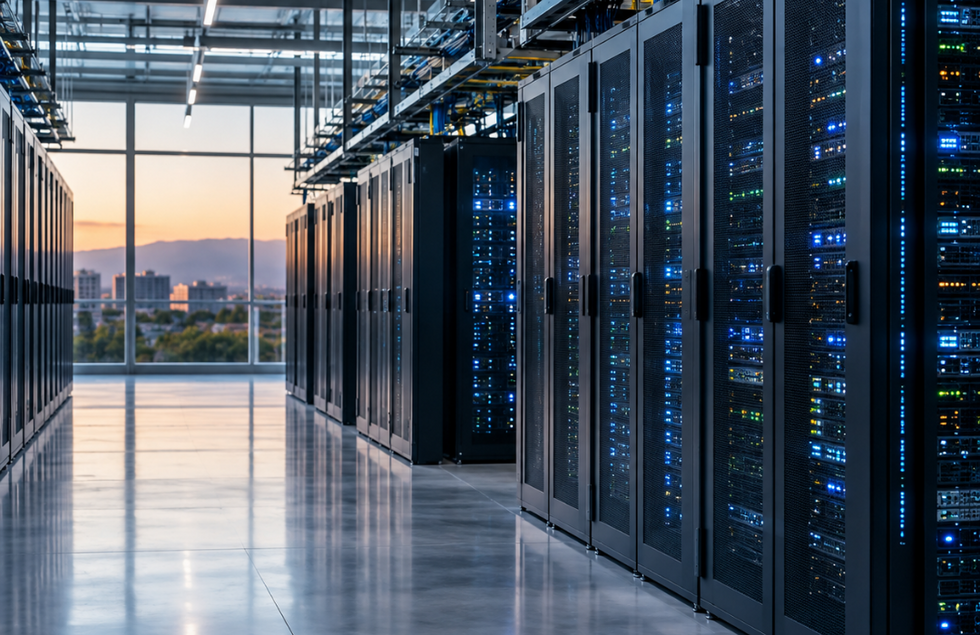
California's data center market is entering a period of significant growth. Artificial intelligence, cloud computing, digital commerce, and the continued migration of businesses to data-intensive platforms are driving demand for infrastructure capable of operating around the clock.
The numbers tell part of the story. California has more than 200 active data centers, according to the California Energy Commission (CEC). In early 2026, data centers represented approximately 1,000 megawatts of demand, or roughly 2% of peak demand within the California Independent System Operator. The CEC projects that figure could rise to approximately 4,500 megawatts by 2040.
For investors and developers, however, demand does not eliminate risk.
A parcel may be valuable commercial real estate and still be a poor data center site. A lease may appear favorable until the tenant discovers that sufficient power cannot be delivered on the expected timeline. A development agreement can become the foundation for years of litigation if the parties never clearly allocated the risk of utility delays, permitting problems, construction changes, or cost overruns.
For U.S. and international investors alike, the legal work should begin before the capital is committed.
1. Buying the Land Is the Easy Part. Determining Whether It Can Support the Project Is Harder.
Traditional commercial real estate due diligence remains essential: title, easements, environmental conditions, zoning, access, neighboring uses, and development restrictions all matter.
For a data center, those questions are only the beginning.
One of the most important issues is power. Investors should distinguish between electricity being located near a site and electricity actually being available to serve the contemplated project at the required capacity and within the required timeframe.
That means investigating the proposed load, utility infrastructure, required upgrades, substations, transmission or distribution constraints, construction responsibilities, estimated energization dates, and who will bear the cost if the original assumptions change.
California's regulatory landscape makes that diligence increasingly important. State and federal regulators are actively considering how significant new loads, including data centers, should connect to and affect the electric system. As of September 2026, proceedings concerning the interconnection of large loads and related transmission issues remain active.
Land-use and environmental diligence can be equally important. Backup generation, air-quality requirements, noise, cooling infrastructure, water use, utility corridors, and local development standards can materially affect a project's economics.
The CEC itself does not generally permit the data center building. It can, however, have jurisdiction over certain associated thermal generation facilities. Projects may also require approvals from local land-use authorities, air districts, utilities, and other agencies, with environmental review under the California Environmental Quality Act (CEQA) potentially playing a significant role.
The practical lesson is simple: do not acquire a property first and determine whether it can function as the intended data center later.
2. The Contract Should Answer What Happens When the Project Does Not Go According to Plan
Data center transactions require more than a standard purchase agreement, industrial lease, or construction contract.
The documents should address the risks most likely to affect the economics of the project.
What happens if the anticipated power capacity is delayed for twelve months? Who bears the cost of an unexpected utility upgrade? Can a purchaser terminate if required entitlements cannot be obtained? What happens if construction costs increase substantially because the electrical or cooling design changes? Can a tenant walk away if the facility cannot be energized by a specified outside date?
Those questions should be answered before a dispute occurs.
Depending on the transaction, parties may need carefully drafted provisions addressing utility milestones, development contingencies, power-capacity assumptions, construction deadlines, cost allocation, change orders, tenant improvements, force majeure, indemnification, insurance, termination rights, guarantees, and dispute resolution.
For investors, this is not simply legal housekeeping. It is risk allocation.
A properly structured agreement identifies which party bears a particular risk while the parties still have bargaining power. A poorly structured agreement leaves that determination for lawyers, arbitrators, or courts after the money has already been spent.
3. International Investment Adds Another Layer of Due Diligence
International companies investing in California face the same real estate, construction, utility, and contractual risks as U.S. investors, but the structure of the transaction can create additional considerations.
Before acquiring or leasing property, an international investor may need to examine the U.S. ownership structure, parent-company guarantees, authority of foreign signatories, cross-border funding arrangements, tax coordination, governing law, dispute-resolution provisions, and the practical enforceability of contractual rights across jurisdictions.
Certain transactions also warrant analysis under the Committee on Foreign Investment in the United States (CFIUS).
CFIUS does not automatically apply simply because a foreign person buys U.S. real estate. Its jurisdiction depends on the nature of the transaction, the parties, the business involved, and, for certain real estate transactions, the property's location relative to designated military installations, airports, maritime ports, and other covered locations. Treasury expanded the geographic scope surrounding numerous military installations in rules effective in December 2024.
For international investors, the better approach is therefore not to assume that CFIUS applies, or that it does not. The transaction should be screened early enough that any potential issue can be addressed before closing becomes dependent on it.
The Best Time to Address a Data Center Dispute Is Before There Is One
California's data center expansion presents substantial opportunities, but these are infrastructure-intensive investments where real estate, energy, construction, regulation, and commercial contracts intersect.
That intersection is also where expensive disputes begin.
Before signing a purchase agreement, committing to a long-term lease, beginning construction, or deploying international capital into a California project, investors should understand not only whether the transaction can close, but whether the project can actually operate as intended.
Kimura London & White LLP represents U.S. and international businesses in complex commercial real estate matters, business transactions, development disputes, and business litigation throughout California. If your company is evaluating a California data center acquisition, lease, development, or investment, contact our team to discuss the legal and commercial risks before capital is committed. Contact our team today! 949.474.0940
This article is provided for general informational purposes and does not constitute legal advice. Legal requirements vary depending on the property, project, transaction structure, and parties involved.

Comments
There are no comments for this post. Be the first and Add your Comment below.
Leave a Comment