
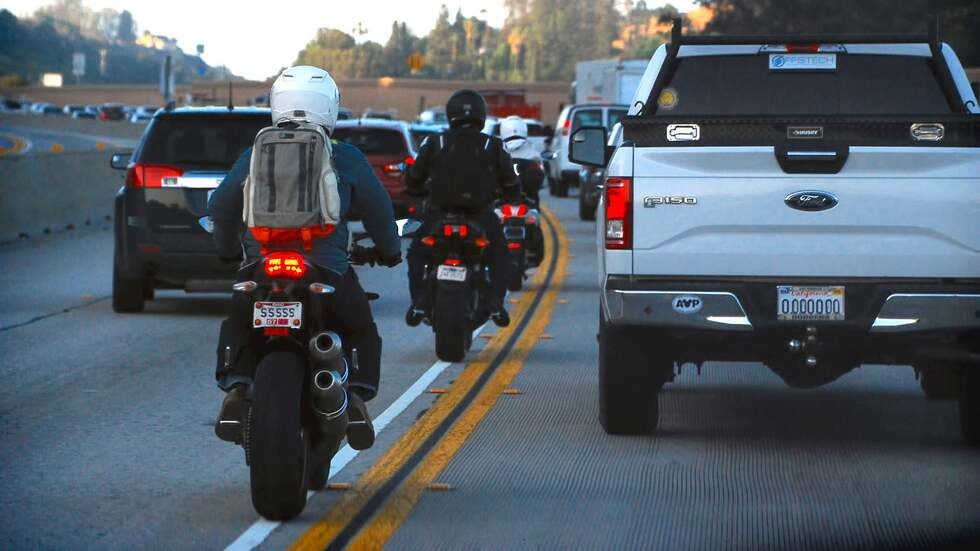
Is lane splitting legal in California? If you ride in Southern California traffic, you probably ask yourself that a lot. Is lane splitting legal in California, or are you risking a ticket every time you move between cars on the 405 or 5?
If you are like most riders, you have heard ten different answers. Your friend says it is fine. A cop once told you to "be careful." Your non-rider coworker is sure it is illegal. No wonder it feels confusing.
You should not have to guess about something that could affect your safety, your license, and even your right to compensation after a crash. So let us walk through what the law actually says. We will also look at how lane splitting works in practice and what riders and drivers need to know on California roads right now.
Table of Contents:
- Is lane splitting legal in California under current law?
- How California became the first state to legalize lane splitting
- How the CHP looks at safe lane splitting
- What the statute actually says about lane splitting
- What "safe" lane splitting really looks like
- How safe is lane splitting according to research
- Lane splitting versus lane sharing and lane filtering
- How other states treat lane splitting
- What the National Highway Traffic Safety Administration says
- Common injuries from lane splitting crashes
- How fault works in a California lane splitting accident
- What happens if someone leaves the scene
- How common lane splitting really is
- What drivers need to know about California lane splitting
- Is lane splitting legal in California in all traffic situations
- How lane splitting affects injury claims and compensation
- How other areas treat things that are legal in California
- Why clear policies and rules matter for riders
- Conclusion
Is lane splitting legal in California under current law?
Yes, lane splitting is legal for motorcyclists in California. Lane splitting became officially legal in California on January 1, 2017, making California the first and only U.S. state to explicitly legalize the practice.
The code defines lane splitting as a motorcycle riding between rows of stopped or moving vehicles going in the same direction on any type of street or highway. It covers both divided and undivided roads. The key part is that riders may lane split only when it can be done safely.
So the short legal answer to the question "Is lane splitting legal in California?" is yes. But the real-life answer is yes, with limits and judgment. The statute does not spell out an exact speed or traffic condition that makes lane splitting safe.
This creates a gray area where safety becomes the priority. Riders must understand the splitting laws to avoid penalties. Ignorance of the specific lane splitting laws is not a valid defense.
How California became the first state to legalize lane splitting
For decades, lane splitting in California lived in a strange space. It was not clearly banned, but it also was not officially approved. Riders did it every day, especially in gridlocked Los Angeles and Orange County traffic.
As motorcycle use grew, the California Highway Patrol started sharing informal guidelines on lane splitting. Those early tips were meant to help riders judge safe speed differences. The goal was to avoid weaving in and out of lanes dangerously.
Then lawmakers passed AB 51. This bill directed the state to define lane splitting in the vehicle code. It also asked the CHP to set formal safety guidelines.
That bill led straight to California Vehicle Code section 21658.1, the law allowing motorcyclists to split lanes explicitly. From that point on, there was no more guessing. The law allowing the practice was officially on the books.
How the CHP looks at safe lane splitting
Even though the lane splitting law is short, the CHP fills in many of the gaps. Through the California Motorcyclist Safety Program, they publish detailed tips for riders who split lanes in traffic. The California Highway Patrol emphasizes that safety is paramount.
According to CHP guidance, riders should think about several factors at once. Speed of traffic, your speed, your skill level, road conditions, weather, and driver behavior all matter. You are not expected to be perfect, but you are expected to be reasonable.
The CHP warns drivers that blocking a motorcycle or crowding them out is illegal. You will see that message on the CHP lane splitting safety page and in their outreach campaigns. So both riders and drivers have a role in keeping this practice as safe as possible.
What the statute actually says about lane splitting
The core lane splitting law, Vehicle Code section 21658.1, does two main things. It defines the practice, and it directs the CHP to create and post safety guidelines. It does not turn lane splitting into a free pass to ride any way you want. You can find the full text of California Vehicle Code Section 21658.1 on the California Legislative Information website.
The statute makes it clear that riders may lane split on California streets, roads, and highways. But it keeps the "if done safely" language. This leaves room for law enforcement to decide when someone has crossed the line into reckless behavior.
That is where another section of law comes in. Under Vehicle Code section 23103, a motorcyclist can face a reckless driving charge if their lane splitting shows a willful or wanton disregard for people or property. That charge is a big deal, with criminal penalties and serious insurance fallout.
What "safe" lane splitting really looks like
If the law and CHP agree that lane splitting must be safe, what does that actually mean on the road? It is helpful to think in terms of practical guidelines, not hard rules carved in stone. Experienced riders know that conditions change in seconds.
The CHP and many safety groups tend to favor these core ideas. Traffic should be slow or stopped, not moving at full highway speeds. Your speed should be reasonably close to the flow of traffic, not far above it.
Many safety experts suggest a smaller speed difference between you and nearby cars. For example, keeping the gap around ten or fifteen mph faster than the cars, rather than twenty or more. The wider the gap, the less time you have to react if a driver suddenly changes lanes or drifts.
Riders should also avoid splitting when traffic is moving freely at the speed limit. If the road straightens and cars speed up, it is better to merge back into a lane.
How safe is lane splitting according to research
You may wonder whether all this talk of safe lane splitting holds up in actual crash data. That is where research out of UC Berkeley gets interesting. A 2015 study by researchers there looked closely at motorcycle collisions on California roads.
That study, highlighted on the UC Berkeley news site, found that only about 17 percent of motorcycle crashes in their sample involved lane splitting. So most motorcycle accidents were happening in other situations. These included normal lane riding, left turn issues, or rear-end collision impacts while stopped.
The UC Berkeley SafeTREC study analyzed nearly 6,000 motorcycle collision reports and found that lane-splitting riders were significantly less likely to suffer head injuries, torso injuries, or fatal injuries compared to non-lane-splitting riders.
When done correctly, splitting can make the motorcyclists safer by removing them from the crush zone. A safer road environment often involves giving motorcycles a way to escape being sandwiched.
Lane splitting versus lane sharing and lane filtering
The motorcycle world throws around several terms that sound alike. Lane splitting, lane sharing, lane filtering. Each can describe something slightly different, and other states sometimes use these phrases in their statutes.
The following table breaks down these differences to help with understanding lane splitting terminology:
| Term | Definition | Typical Context |
|---|---|---|
|
Lane Splitting |
Riding between rows of moving or stopped vehicles. |
Legal in California for all traffic speeds (if safe). |
|
Lane Filtering |
Moving between stopped cars to the front at a red light. |
Legal in states like Utah; often limited to low speeds. |
|
Lane Sharing |
Two motorcyclists riding side-by-side in one lane. |
Often allowed, distinct from passing cars. |
If you want a quick breakdown, this lane splitting guide for riders walks through the basic language in an easy format. You will see how California's legal definition compares with how other states talk about the same kinds of moves.
Another helpful write-up looks at the difference between biker lane sharing and lane splitting. That resource explains how riders might share a single lane side by side in some settings. In contrast, lane splitting is specifically about passing between vehicles in adjoining lanes.
How other states treat lane splitting
Even today, California is still out front on this issue. As of now, California is the only state that fully recognizes lane splitting as legal across most roads. This is noted in summaries that reference California law and practice.
Some states have started experimenting with narrower laws. Utah has a limited lane filtering law. That approach shows up in summaries tied to the Utah lane filtering guidelines, where riders can filter between lanes only at lower speeds and in certain situations.
Arizona moved ahead with a similar but separate structure. Lawmakers passed AZ SB1007 and also reference rules in Arizona Revised Statute section 28-729. Montana took another path with a law in Montana Code Annotated section 61-8-392.
Some state lawmakers, like in Oregon, have even pushed forward new proposals. This is mentioned in this piece on the Oregon Senate passing a lane splitting bill. That one still needs further action, but you can see where the conversation is going across the country.
What the National Highway Traffic Safety Administration says
The National Highway Traffic Safety Administration has looked at lane splitting from a safety and crash standpoint. In one of its past reviews of motorcycle operations, the agency noted that lane splitting on multilane roads might slightly reduce accident frequency compared with staying in line with traffic.
You can see some of that analysis in a federal summary on motorcycle crashes and behavior on the NHTSA motorcycle research page. It is not a simple "safe versus unsafe" verdict. However, the picture is more balanced than most non-riders expect.
Of course, any vehicle accident that happens during lane splitting can still be severe. A rider who gets hit at a bad angle or thrown into another lane can suffer traumatic injuries even with full gear. Passenger vehicles provide a cage of safety that motorcycles lack.
Common injuries from lane splitting crashes
Common motorcycle accident injuries from lane splitting crashes include road rash, broken bones, traumatic brain injuries (TBI), spinal cord injuries, and internal organ damage.
Motorcycle accidents, including those involving lane splitting, tend to produce certain injuries more often. That is because the rider does not have a protective metal frame like a driver in a car. A personal injury claim often follows these serious wrecks.
Head and brain injuries are some of the worst outcomes, even for riders who wear good helmets. The National Institute of Neurological Disorders and Stroke explains how traumatic brain injuries can disrupt thinking, movement, and personality in deep ways.
On the emotional side, crashes can also lead to anxiety, depression, or post-traumatic stress. The National Institute of Mental Health has clear information about PTSD and other emotional aftereffects of serious events like vehicle crashes.
Other serious outcomes include spinal damage and wrongful death. An accident lawyer usually handles these high-stakes cases. While a firm's practice areas might include dog bites, sexual abuse, truck accidents, or bicycle accidents, handling a motorcycle lane splitting case requires specific traffic law knowledge.
How fault works in a California lane splitting accident
Because lane splitting is legal here, fault after a crash is not as simple as "the biker should not have been there." Insurance adjusters and courts have to look closely at everyone's behavior. They cannot just blame the rider's decision to split lanes.
If a driver made an unsafe lane change without checking mirrors, they can carry much of the blame. If the rider was lane splitting in slow traffic with a modest speed difference, that is consistent with safer use of the practice. Slower-moving traffic is the ideal environment for splitting.
On the other hand, a rider flying through stop-and-go lanes at high speed might face an argument that they were reckless. In extreme cases, that behavior could line up with the definition of reckless driving under Vehicle Code section 23103. An experienced motorcycle accident attorney can help demonstrate that you were riding prudently. California follows a pure comparative negligence rule, meaning even if you're found 99% at fault, you can still recover 1% of damages from the other party.
What happens if someone leaves the scene
If a lane splitting crash turns into a hit and run, things get more serious in a hurry. California law comes down hard on drivers and riders who leave an accident with injuries or serious property damage.
Under Vehicle Code section 20001, leaving the scene of an injury crash is a criminal offense. That can mean jail time, heavy fines, and long-term consequences on your record.
This is one of many reasons why legal help can matter after a motorcycle accident. Fault, injuries, and insurance arguments all stack up quickly once police reports and medical records start to appear. An attorney can also check if any nearby truck accident or surveillance cameras captured the event.
How common lane splitting really is
If you spend any time on freeways through Orange County, you probably already know the answer. Lane splitting is a part of daily life here. It is especially common during the morning and evening rush.
Survey results highlighted in a KQED article on lane splitting showed that about 80 percent of California motorcyclists lane split on freeways at least some of the time. Many use it as a regular way to cut through backups and avoid sitting exposed in slow lines.
Riders often describe lane splitting as one of the biggest advantages of owning a motorcycle here. It offers shorter commute times and less time sitting in stop-and-go conditions. In some cases, it leads to fewer rear-end near misses when motorcyclists split the traffic properly.
What drivers need to know about California lane splitting
If you are in a car or truck, you might feel uneasy seeing a bike appear between lanes. That is natural if you grew up in states where lane splitting was always called illegal. But in California, your responsibilities are clear.
CHP safety guidance points out that drivers may not crowd a lane or move over just to block a motorcyclist who is lane splitting. Deliberately opening a door, swerving, or "teaching the biker a lesson" is dangerous. It can expose you to serious liability for car accidents.
Instead, you should check mirrors, use turn signals, and hold a predictable path within your traffic lane. Even a small drift into the gap between lanes can give a rider nowhere to go. Staying steady gives everyone more time and space to react.
Is lane splitting legal in California in all traffic situations
Lane splitting is legal across California, but that does not mean it is smart in every setting. The statute's safety requirement gives officers room to look at context. Your speed, weather, lighting, traffic pattern, and the way other drivers were behaving all play a role.
High speed splitting between cars moving at or above the limit on a crowded freeway will always be more risky. Dark, rainy, or poorly lit roads cut down the reaction window even more. In those moments, patience might be the safest move to avoid a lane-splitting accident.
If you lose control on wet pavement between cars, the legal repercussions are severe. By contrast, carefully rolling between lanes of stopped traffic in bright conditions is safer. It gives you more options if someone is texting behind you and not slowing down.
Many riders argue that the ability to split helps alleviate traffic. However, the primary goal of the law is safety, not just to alleviate traffic congestion. Extreme caution is required at all times.
How lane splitting affects injury claims and compensation
If you were lane splitting at the time of a crash, insurers may try to argue you share some of the blame. That is common. But shared blame is not the same thing as losing your right to compensation.
Because California uses comparative fault principles, your recovery can be reduced but not erased if you carry part of the fault. The details matter. The speed limits, traffic density, and driver signals are all critical factors.
Legal teams look at every one of these details. They review camera footage, skid marks, vehicle damage, and medical records. These facts, along with clear knowledge of motorcycle lane splitting laws, help shape the outcome of your case.
If a wrongful death occurs, the family needs a lawyer who understands the nuances of the California motorcycle lane laws. A generalist might miss key arguments regarding moving lanes and right of way.
How other areas treat things that are legal in California
One helpful way to think about lane splitting in California is to remember that legality changes with borders. The same way sports betting rules can change from one state to the next, so can motorcycle practices.
A breakdown like this guide on whether sports betting is legal in California shows how different states move at their own pace. Lane splitting works the same way. Here, it is legal within clear bounds. Across the line, it may be limited or fully banned.
If you ever ride outside California, check those rules first. You do not want to bring California habits into a state that has not updated its codes yet. What is a legal motorcycle lane maneuver here might get you pulled over in Nevada.
Why clear policies and rules matter for riders
Clear policies about acceptable road use protect everyone. The idea shows up across law and technology. For example, an online platform may have a detailed Acceptable Use Policy that spells out what users can and cannot do.
On the road, California's lane splitting statute and the CHP safety guidelines do something similar. They take a practice that was already happening and put structure around it. That gives riders, drivers, officers, and courts a shared reference point regarding the term âlane splittingâ (lane splitting).
The result is less guessing and more predictability. You know what the baseline rules are. From there, the real focus turns to how safely each person followed those rules in a specific situation involving highway traffic.
Using the proper motorcycle lane splitting techniques makes the roads safer for everyone. When rules are clear, motorcyclists riding in traffic moving faster or slower can predict driver behavior better.
Conclusion
Is lane splitting legal in California? Yes, it is. That fact shapes daily traffic from Irvine through the rest of Orange County and beyond. But that legal status comes with responsibility, judgment, and real consequences if someone acts recklessly.
Lane splitting is legal because lawmakers and safety experts see that it can reduce certain risks when done with care. At the same time, the statutes on reckless driving, hit and run, and safe operation all still apply. Each crash becomes a close look at what every person did or failed to do in those few seconds before impact.
If you ride, it helps to know both your rights and your duties on the road. If you drive, it helps to remember that the bike passing between lanes beside you has every right to be there under California law. And if a California motorcycle accident happens, you do not have to guess your way through fault, insurance, and injuries. Legal guidance grounded in the real statutes and safety research can give you a much clearer path forward.
Contact our team here at Kimura London & White LLP by calling 949-474-0940 or filling out a confidential contact form.
Disclaimer:
This blog post is for informational purposes only and does not constitute legal advice. Lane splitting laws and regulations may change, and each accident case is unique. If you have been involved in a motorcycle accident or have questions about your legal rights in California, please consult with a qualified personal injury attorney who can evaluate your specific situation. Nothing in this article creates an attorney-client relationship.

Comments
There are no comments for this post. Be the first and Add your Comment below.
Leave a Comment